

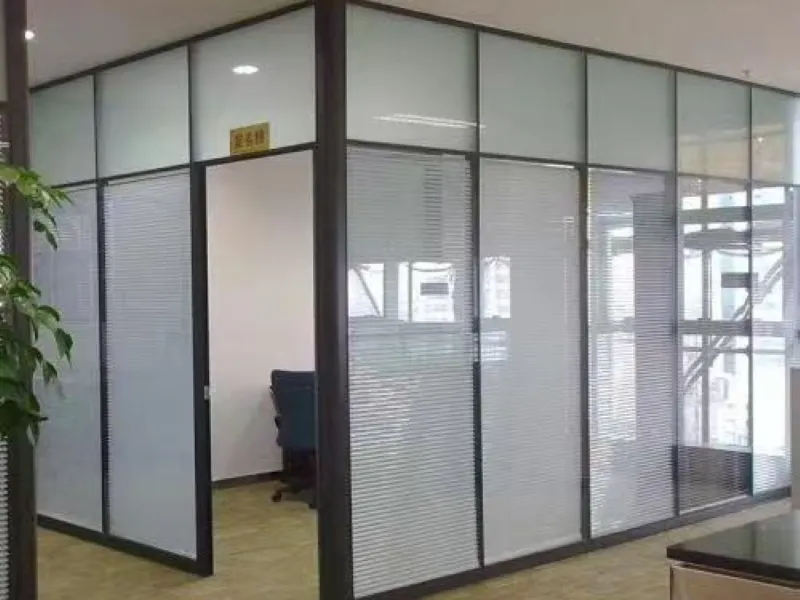
Tempered glass for partitions are increasingly becoming the popular choice in office and commercial space designs. According to market research, the glass partition market is growing as the demand for transparency and aesthetics in office spaces rises. However, installation costs and meeting statutory regulations are also becoming key factors in making procurement decisions.
As far as tempered glass partition systems are concerned, the installation cost is hardly ever just the price of the materials used. It is usually a comprehensive consideration of materials, processing, design, construction, and on-site coordination. Data from the International market indicates that the average installation cost of high-quality glass partitions ranges from $100 to $250 per square foot, with higher safety or certification requirements further increasing the costs.
Pricing from the market also points to significant price variations between various types of glass partitions. For example, standard framed glass partitions cost between $35-$80 per square foot, while frameless or high-end models can reach $50-$150 per square foot. The use of a glass with higher sound insulation or fire resistance ratings will consequently increase the cost of raw materials and construction.
Looking at the materials side of things, tempered glass is more costly than traditional partition solutions such as drywall. However, from a viewpoint of long-term use and maintenance, the maintenance cost per square meter is lower, and the glass is more durable, thus the total cost of ownership may be more competitive.
Compliance Requirements and Their Impact on Procurement
Safety standards for glass partitions are clearly outlined in building codes in most countries and regions. Apart from generally requiring glass thickness and impact resistance to be in accordance with the standards (such as the test classifications of ISO 12543 or EN 12600), many localities also have specific requirements regarding the structural safety, fragmentation safety characteristics, and fire resistance of the partitions.
As an example, certain local regulations might necessitate the partition glass to break into fairly blunt pieces upon heavy impact to minimize the risk of injury, or a higher safety-certified tempered glass be used in areas with high foot traffic. Building codes also typically require that glass partitions in public areas and near emergency exits have higher impact resistance, or else they could be rejected.
Compliance intricacies are also demonstrated in the global market. Countries and regions have different regulations and standards. For instance, some international standards mandate that partition systems have to provide a full list of on-site certified materials and obtain approval from the regulatory agencies before construction. In the case of cross-border trade and project bidding, procurement teams will have to carry out more pre-construction compliance assessment work.
Construction Technology Challenges and On-site Management Costs
It is more of a hassle to work with tempered glass for partitions as compared to lightweight partitions. The glass sheets are both heavy and delicate, thus the services of an expert construction crew are definitely needed to do on-site dimensional measurements, support design, benchmarking, calibration, etc. Construction deviations, misalignment of the frame system, and the like may happen, and all these lead to extra construction costs.
For instance, without any frame, thetempered glass for partition should be designed with a very specific load-bearing and fixing system, thus their construction costs will be much higher than the conventional framed ones. Moreover, even different installation methods within the same project can hugely affect construction time and labor costs, with the latter directly influencing on-site scheduling and project delivery.
Procurement Recommendations and Cost Control Strategies
Purchasers in the B2B market would benefit from tempering their glass partition procurement decisions after thoroughly understanding the various factors involved, such as:
Set Goals and Criteria for Success Precisely. When it comes to office partitions, a good combination of visual transparency along with privacy and sound insulation is necessary; hence thickness and glass type should be chosen based on the function of the space.
Compliance with Regulations Should Be the Priority: ...Check the requirements for building codes and fire safety standards in the place to be confident that the chosen products will pass inspections without problems.
Taking into account the level of supplier standardization and delivery ability: Mass production through standardization and working with well-versed supply chain partners can actually eliminate a lot of risks and make the project more efficient.
What Your Money Goes For: When you are setting your budget, think of the total cost (materials, installation, compliance checks, and maintenance) instead of just focusing on the unit price.
Given the rising demand for beauty and openness in commercial space planning, and the sustained expansion of the tempered glass partition industry, the buyers should not only glance at product quality but also at installation costs and building code compliance—two very crucial factors. Once they've deeply analyzed the cost structure, regulatory safety certifications, and the supplier's real on-ground capabilities, the procurement team will be in a better position to control project risks, thus balancing space design and budget goals.
