

At Shenyang Aolide Glass, we often receive inquiries from architects and contractors asking: "Should I use tempered glass for everything to be safe?"
The answer is: Not necessarily. While both are heat-treated, choosing the wrong one can lead to project delays or even safety hazards. As a professional glass manufacturer, we’ve broken down the technical differences and real-world applications to help you make an informed decision.
1. The Technical Breakdown: Surface Compression
To meet international standards (such as ASTM C1048 or EN 12150), we precisely control the cooling process in our tempering furnace.
Tempered Glass (Fully Tempered): We process this to a surface compression of above 10,000 psi (69 MPa). This makes it 4-5 times stronger than standard annealed glass.
Heat-Strengthened (HS) Glass: We cool this glass more slowly, targeting a surface compression between 3,500 and 7,500 psi (24–52 MPa). It is roughly 2 times stronger than annealed glass.
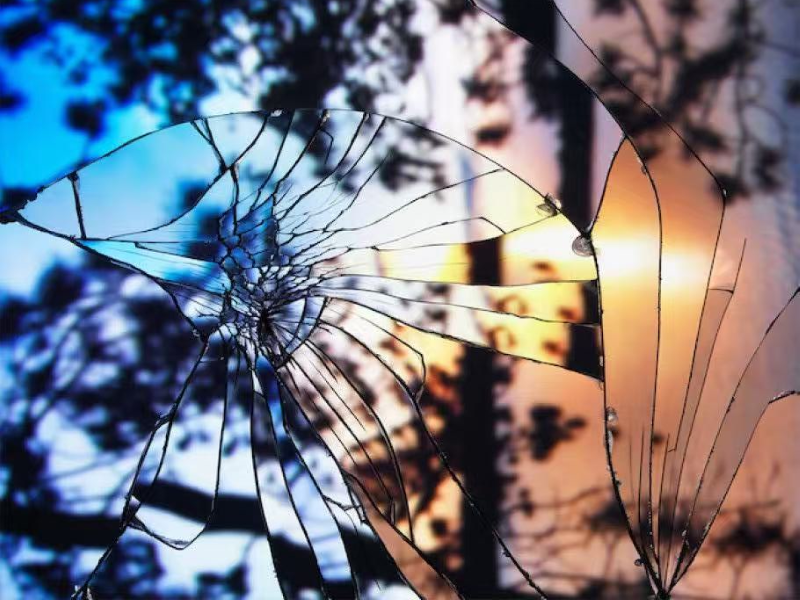
2. The Breakage Pattern: Safety vs. Stability
The most visible difference occurs when the glass breaks. In our testing lab, we observe two distinct patterns:
Tempered Glass (The "Dice" Pattern): Upon impact, it shatters into thousands of small, blunt-edged granules (like popcorn). This minimizes the risk of serious injury, which is why it's classified as Safety Glass.
Heat-Strengthened Glass (The "Spider Web"): It breaks into larger, jagged shards that tend to stay locked in the window frame. Because these shards are sharp, HS glass is NOT considered safety glass on its own under most building codes.
3. Pro Advice: When do we recommend HS over Tempered?
While tempered glass is stronger, our engineers often recommend Heat-Strengthened Laminated Glass for high-rise curtain walls. Why?
Spontaneous Breakage Risk: Tempered glass has a tiny risk of "self-explosion" due to Nickel Sulfide (NiS) inclusions. In a high-rise, a falling cloud of tempered glass "popcorn" can still be dangerous.
Fallout Protection: If a tempered pane breaks, the entire sheet disintegrates and can fall out of the frame. However, if HS glass breaks, the larger shards wedge themselves together, staying in place until the pane can be replaced. For overhead glazing and high-rise facades, HS + Laminated is often the superior choice.
4. The "Pitfall" Corner: A Real-World Lesson
We once worked with a client who insisted on using single-pane tempered glass for a high-altitude glass walkway, claiming it would "save costs." We intervened and explained that while tempered glass is strong, its tendency to shatter upon a single point of failure completely makes it a "sudden death" risk for walkways.
Our Advice: For structural glass where "post-breakage stability" is life-critical, always use Heat-Strengthened Laminated Glass instead of just single-pane tempered.
5. Quality You Can Trust: CCC & Beyond
All glass produced at theShenyang Aolide Glass factory undergoes rigorous stress testing. While we carry the China Compulsory Certification (CCC)—the baseline for quality and safety in Chinese manufacturing—our production lines are also calibrated to meet the high-performance requirements of European and American markets.
